Monday, August 18, 2014

August Audiobook Giveaway!


To celebrate August, the last month of summer, I have 9 great audiobooks available for a giveaway, courtesy of Penguin Audio. I have descriptions from Goodreads of each book below. If you would like to win one of the audiobooks, please leave a comment describing which audiobooks are your top two picks and why they sound interesting.

As part of your comment, you must include an email address. If I can't find a way to contact you I will draw another winner.
For an additional entry, blog about this giveaway or post it on your sidebar. Provide a link to this post in your comment.

I will be using random.org (or a Monte Carlo simulation in excel) to pick the winners from the comments.

This contest is only open to US and Canadian residents (Sorry!).

No P.O. Boxes.

The deadline for entry is midnight on Sunday August 31st.

Please make sure to check the first week of September to see if you are a winner. I send emails to the winner, but lately I've been put in their "junk mail" folder instead of their inbox.

Good luck!

Affliction by Laurell K. Hamilton
Some zombies are raised. Others must be put down. Just ask Anita Blake.


Before now, she would have considered them merely off-putting, never dangerous. Before now, she had never heard of any of them causing human beings to perish in agony. But that’s all changed.

Micah’s estranged father lies dying, rotting away inside from some strange ailment that has his doctors whispering about “zombie disease.”

Anita makes her living off of zombies—but these aren’t the kind she knows so well. These creatures hunt in daylight, and are as fast and strong as vampires. If they bite you, you become just like them. And round and round it goes…

Where will it stop?
Even Anita Blake doesn’t know.

Dark Lycan by Christine Feehan
“The erotic, gripping series that has defined an entire genre” (J. R. Ward) continues as #1 New York Times bestselling author Christine Feehan links the fates of two strangers bound by a secret in the shadows of the Carpathian Mountains…

Tatijana of the Dragonseekers spent centuries encased in ice with her sister, trapped in limbo between life and death, never speaking to a soul other than those who tormented her. Now, she has been freed from her frozen prison by an unknown descendent. Awakened in human form, Tatijana yearns to explore the modern world in which she now lives—a world with more mysteries than she is prepared for.

Fenris Dalka has returned to the Carpathian Mountains after a long absence to be with his brother. He is scarred by centuries of battle, and every hard-won victory. But the real reason for his return home could prove deadly if discovered by the wrong man—or woman. Upon his arrival, he is compelled by a beautiful and enigmatic stranger who carries the scent of fresh earth, of forest, of the night itself.

In time Tatijana and Fenris will discover all that unites them—their secrets and pasts, their predators, and the hot flush of passion that stirs their souls. Yet just as surely, seduced into the silvery darkness of a full-moon night, they’ll also discover everything ancient and evil that exists to destroy them.

Includes a teaser for Christine Feehan’s next Carpathian novel, Dark Wolf.


The Map and the Territory by Alan Greenspan
Like all of us, though few so visibly, Alan Greenspan was forced by the financial crisis of 2008 to
question some fundamental assumptions about risk management and economic forecasting. No one with any meaningful role in economic decision making in the world saw beforehand the storm for what it was. How had our models so utterly failed us?

To answer this question, Alan Greenspan embarked on a rigorous and far-reaching multiyear examination of how Homo economicus predicts the economic future, and how it can predict it better. Economic risk is a fact of life in every realm, from home to business to government at all levels. Whether we're conscious of it or not, we make wagers on the future virtually every day, one way or another. Very often, however, we're steering by out-of-date maps, when we're not driven by factors entirely beyond our conscious control.

The Map and the Territory is nothing less than an effort to update our forecasting conceptual grid using twenty-first-century technologies. It integrates the history of economic prediction, the new work of behavioral economists, and the fruits of the author's own remarkable career to offer a thrillingly lucid and empirically based grounding in what we can know about economic forecasting and what we can't. The book explores how culture is and isn't destiny and probes what we can predict about the world's biggest looming challenges, from debt and the reform of the welfare state to our competition with China to natural disasters in an age of global warming.

No map is the territory, but Greenspan's approach, grounded in his trademark rigor, wisdom, and unprecedented context, ensures that this particular map will assist in safe journeys down many different roads, traveled by individuals, businesses, and the state


Eminent Hipsters by Donald Fagen
Musician and songwriter Donald Fagen presents a group of vivid set pieces in his entertaining debut
as an author, from portraits of the cultural figures and currents that shaped him as a youth to an account of his college days and of life on the road.

Fagen begins by introducing the “eminent hipsters” that spoke to him as he was growing up in a bland New Jersey suburb in the early 1960s, among them Jean Shepherd, whose manic nightly broadcasts out of WOR-Radio “enthralled a generation of alienated young people”; Henry Mancini, whose swank, noirish soundtracks left their mark on him; and Mort Fega, the laid-back, knowledgeable all-night jazz man at WEVD who was like “the cool uncle you always wished you had.” He writes of how, coming of age during the paranoid Cold War era, one of his primary doors of escape became reading science fiction, and of his invigorating trips into New York City to hear jazz. “Class of ’69” recounts Fagen’s colorful, mind-expanding years at Bard College, the progressive school north of New York City, where he first met his future musical partner Walter Becker. “With the Dukes of September” offers a cranky, hilarious account of the ups and downs of a recent cross-country tour Fagen made with Boz Scaggs and Michael McDonald, performing a program of old R&B and soul tunes as well as some of their own hits.

Acclaimed for the elaborate arrangements and jazz harmonies of his songs, Fagen proves himself a sophisticated writer with a very distinctive voice in this engaging book.


Think and Grow Rich “Stickability”:  The Power of Perseverance by Greg S. Reid
The path to personal and professional success is not a one-way street. Most people encounter
setbacks and obstacles that threaten to derail them from their chosen route. The most successful people, however, adhere to their principles and goals, capitalizing on hidden opportunities, even in the face of what many would consider unconquerable obstacles. To coin a new word—these people have STICKABILITY!

This thought-provoking book shows readers of all ages and backgrounds how they, too, can not only apply the self-motivation principles of Napoleon Hill’s timeless and groundbreaking self-help volume Think and Grow Rich, but make them stick. Combining author Greg S. Reid’s modern business wisdom, interviews with numerous business celebrities like Steve Wozniak (co-founder of Apple), Frank Shankwitz (founder of the Make a Wish foundation), and Martin Cooper (inventor of the cell phone), and valuable information from the secret files previously available only to the Napoleon Hill Foundation and its members, this book will reveal:

The “Three Causes of Failure” from Napoleon Hill’s hidden vault of wisdom The importance of flexibility The principle of relaxed intensity in action How to define and conquer your “cul-de-sac” moments How to overcome the ghost of fear The importance of insight through necessity And so much more! Each inspiring chapter will remind readers that if ever a discouraging moment arrives and the temptation to stop becomes greater than the dream, to keep one simple observation from Dr. Hill in mind:

“Most great people have attained their greatest success just one step BEYOND their greatest setback and failure.”

STICKABILITY shows readers just how life-changing this simple principle can be. Additionally, it gives readers an outlines on how to develop their own stickability—and transform their lives forever!(


The Kill List by Frederick Forsyth
In Virginia, there is an agency bearing the bland name of Technical Operations Support Activity, or
TOSA. Its one mission is to track, find, and kill those so dangerous to the United States that they are on a short document known as the Kill List. TOSA actually exists. So does the Kill List.

Added to it is a new name: a terrorist of frightening effectiveness called the Preacher, who radicalizes young Muslims abroad to carry out assassinations. Unfortunately for him, one of the kills is a retired Marine general, whose son is TOSA’s top hunter of men.

He has spent the last six years at his job. He knows nothing about his target’s name, face, or location. He realizes his search will take him to places where few could survive. But the Preacher has made it personal now. The hunt is on.


Doing Hard Time by Stuart Woods
When Stone Barrington embarks on a trip to Bel-Air to check in on some business and personal
concerns, he expects a relaxing break from the fast pace and mean streets of New York.  But trouble never takes a vacation, and it has a way of finding Stone.  A case that had seemingly been resolved has returned in full force—with lethal results.  And this deadly situation makes for strange bedfellows when Stone finds himself teamed with the least likely ally . . . a gentleman of unique abilities, who can fly below the radar and above the law.

From the high-stakes poker tables of Las Vegas to California’s lush beachside resorts, the trail of disguise, subterfuge, and murder leads to a shocking conclusion.(


The Mayan Secrets by Clive Cussler and Thomas Perry
Husband-and-wife team Sam and Remi Fargo are in Mexico, when they come upon a remarkable
discovery—the skeleton of a man clutching an ancient sealed pot, and within the pot, a Mayan book, larger than anyone has ever seen. The book contains astonishing information about the Mayans, about their cities, and about mankind itself. The secrets are so powerful that some people would do anything to possess them—as the Fargos are about to find out.

Before their adventure is done, many men and women will die for that book—and Sam and Remi may just be among them.


Mirage by Clive Cussler with Jack Du Brul
In October 1943, a U.S. destroyer sailed out of Philadelphia and supposedly vanished, the result of a Navy experiment with electromagnetic radiati
on. The story was considered a hoax—but now Juan Cabrillo and his Oregon colleagues aren’t so sure.

There is talk of a new weapon soon to be auctioned, something very dangerous to America’s interests, and the rumors link it to the great inventor Nikola Tesla, who was
working with the Navy when he died in 1943. Was he responsible for the experiment? Are his notes in the hands of enemies? As Cabrillo races to find the truth, he discovers there is even more at stake than he could have imagined—but by the time he realizes it, he may already be too late.

Silent Spring by Rachel Carson


I have a confession to make.  Although I teach Environmental Science, I have never read Silent Spring.  I first learned about it in American Literature in High School and we also discussed in my environmental engineering courses in college.  I know the basics of what the book was about and the importance to the environmental movement.  Knowing the overview did not prepare me for just how powerful and well written this non-fiction book is.  It reads like a science fiction novel, but the truth turns out to be even more frightening then fiction.

Carson starts the book with a powerful fable.  All of the song birds have died, the livestock is sick, and the people have also started to show strange symptoms.  It isn’t nature that caused these hardships, but the people themselves.  Carson explains this hasn’t happened yet, but “what has already silenced the voices of spring in countless towns in America?  This book is an attempt to explain.”

Carson explains how the soil, earth, and air to provide habitat for all of the creatures of the earth.  She discusses these creatures and how even creatures that we deem unimportant, can have an important role in the cycle of life.  She also explains the chemicals that were being used in the 1960’s, how they were applied, and the effects that they had.  Basically the chemicals were being applied indiscriminately and were killing far more than they should.  She talks about both herbicides and insecticides, but the book focused more on insecticides.  The insecticides killed far more insects then what they were aiming for.  They killed everything, including the natural insect predators of the insects they were trying to get rid of. They also would kill the birds that act that insects coated with the insecticides.  They also traveled up the food chain, causing poisoning of birds, fish, and humans.

Luckily the book was not all gloom and doom. Carson also described what could be done.  She implied that certain insecticides such as DDT should no longer be used.  She also discussed how natural predators’ should be introduced to take care of problem pests.  She discussed how insecticides and herbicides could be applied topically to the offending vegetation specifically rather than a blanket spray.  These are all great options and what is typically used by ecologists today.

Distressingly though as I read the book, I realized times had changed, but a lot remains the same.  Different chemicals are used now, but our lives are completely surrounded by chemicals.  What effects to they have on us and the wildlife around us?  The book discussed how insecticides were killing off the honeybees; a problem that has also recently been in the news the past few years.  Are we always so sure what we are applying to land and vegetation does not have any harmful effects on humans and nature?

“The pollution entering our waterways comes from many sources:  radioactive wastes from reactors, laboratories, and hospitals; fallout from nuclear explosions; domestic wastes from cities and towns; chemical wastes from factories.  To these is added a new kind of fallout – the chemical sprays applied to croplands, gardens, forests and fields.  Many of the chemical agents in this alarming mélange imitate and augment the harmful effects of radiation, and within the groups of chemicals themselves there are sinister and little-understood interactions, transformations, and summations of effect.”  This is still true today, particularly with all of the medications ending up in water ways.  We don’t know all of what they are, how to remove them, or how they interact with each other.  We do know it is causing changes in fish.

“The trouble is that we are seldom aware of the protection afforded by natural enemies until it fails.  Most of us walk unseeing through the world, unaware alike of its beauties, its wonders, and the strange and sometimes terrible intensity of the lives that are being lived around us.”  I just loved this quote.  Carson has a wonderful way with words and I also thought this was too true.

I also liked that there were examples in this book from Wisconsin and Michigan; my current state and my state of birth.  In 1954, Michigan State University started spraying their campus for Dutch elm disease.  The following year, there was a sharp decline in the robin population as eggs seemed unable to hatch.   Perhaps most horrifying was how in 1959, Southeast Michigan (including suburbs of Detroit) was heavily dusted with pellets of aldrin to kill the Japanese beetle.  Residents talked about how it looked like snow falling from the sky.  Then they started to report the deaths of songbirds and housecats and the illness of dogs.  Also people that watched the planes had “nausea, vomiting, chills, fever, extreme fatigue, and coughing.”

Overall, I really enjoyed reading this book.  It gives me great examples and discussion points for my environmental science class this fall.  I also enjoyed how Carson was a wonderful wordsmith and did a great job of taking a complex problem and breaking it down so that it was understandable for the average citizen.  There were also great illustrations at the start of each chapter.  I would like to keep this book forever to use for my classes, but I must return it to the library.  I need to purchase my own copy!

Book Source:  Kewaunee Public Library

Monday, August 4, 2014

My Visit to Goodnestone Park by Syrie James (and GIVEAWAY of Jane Austen's First Love)

I am excited to be a stop today on  the virtual tour for Jane Austen's First Love by Syrie James.  Syrie James is one of my favorite Austen and historical fiction authors and I have greatly enjoyed her books in the past.  I've just started reading this novel and it promises to be excellent as well.  Stop back by on August 19th for my review of the novel and the winner of a copy of Jane Austen's First Love (details on how to win are below).  Ms. James has written a wonderful guest blog about her visit to Goodnestone Park, the setting of Jane Austen's First Love.  Read on for the wonderful details, pictures, and an excerpt from the book.

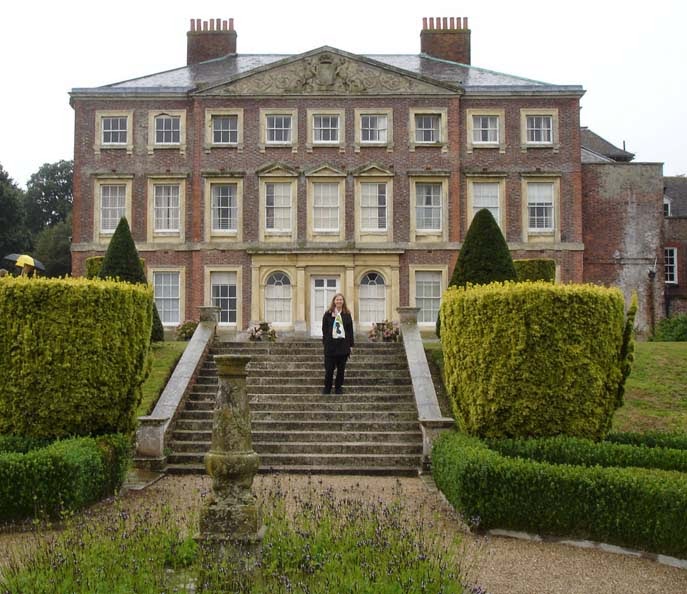
 My novel Jane Austen’s First Love is set primarily at Goodnestone Park, an estate which still exists, and today belongs to the FitzWalter family, descendants of the Bridges family who Jane Austen knew over two hundred years ago. (Read on to the end for a relevant excerpt from the novel!)


Situated in county Kent, England, Goodnestone Park is about nine miles from the cathedral city of Canterbury. The estate, which has been occupied since the Tudor era, was purchased by Brook Bridges, 1st Baronet, who in 1704 demolished the original manor and constructed a new, red and blue brick palladian house, which forms the basis of the house we see today. He also put in extensive, fifteen acre formal gardens, similar to those at Versailles. His grandson, Sir Brook Bridges, 3rd Baronet (who welcomed Jane Austen and her family into his home, after his daughter Elizabeth became engaged to Jane’s brother Edward Austen), made several alterations to the house in the 1770s, and replaced the manicured formal gardens with an open landscape park—a natural look which was more fashionable at the time.

I was privileged to visit Goodnestone Park on a very special Austen tour last autumn. It rained the day we where there, but that couldn’t dampen my spirits. It was such a thrill to see the beautiful, ancient house and grounds where I had set my novel, and to know that Jane Austen had been there herself.

Although Goodnestone House is not open to the public, I applied to the present owners and asked to see the interior, explaining that I was writing a book which took place there and wanted to depict the house as accurately as possible. A very kind family member graciously complied, and gave me and my dear friend and traveling companion, Laurel Ann Nattress, a private tour.

Inside Goodnestone House, I was immediately delighted by its unique, central oval entrance hall, which is embellished with detailed crown moulding and a series of large niches. The walls are adorned with delicate, Italianate paintings featuring floral patterns, cherubs, and scroll-work.  The ante-room and the adjacent drawing room and dining room were designed and furnished by the renowned Scottish architect Robert Mylne around 1770, and feature beautiful Wedgewood moulding around the doors. The ground floor also includes a library and a kitchen (in Austen’s day, the kitchen may have been a gun room or billiards room, since kitchens in her era were in a separate building.) A prominent main staircase in the large, central hallway features a swept and ramped handrail and dado paneling. The upper two floors feature a great many spacious bedrooms.

Walking through those rooms and halls was incredibly helpful to me. With every step I could see the action of my novel taking place in my mind. It was thrilling to know that Jane Austen, members of her family, the Bridges family, Edward Taylor, and all the other people in my novel had walked those very halls and climbed that very staircase!

I enjoyed walking through the beautiful gardens at Goodnestone. There is an immense, natural landscape park at the front of the house, similar to what Jane Austen may have seen. A “holly walk” that leads to Goodnestone Church at the far end of the property, is the same path Jane would have taken when she walked to church with the Bridges family. There are also three large gardens which lead one into the other, each of which is enclosed by high, ivy-covered brick walls. The flora in these gardens may be different now than it was two hundred years ago, but the ancient brick walls are still the same.

It was those high, brick walls which inspired a scene in my novel, Jane Austen’s First Love. Here’s a little excerpt from the relevant part... I hope you enjoy it!

At this point in the story, Jane is newly arrived at Goodnestone Park and has spent the better part of the evening conversing with the handsome and completely fascinating Edward Taylor. They are now exploring the gardens with Jane’s sister Cassandra and Edward’s cousin, Mr. Payler.

“This a lovely garden,” commented Edward Taylor.

“It is,” replied I.

Studying the ancient, mossy, ivy- and vine-covered brick wall surrounding us, he added: “I particularly admire these walls.”

“The walls?” repeated I, amused.

“These walls, according to Lady Bridges, have stood here for more than a hundred years—and will no doubt still be standing two hundred years hence. Fascinating, is it not, to think of all the people who will see them and walk within their confines, long after we have all stopped breathing?”

Mr. Payler laughed and shook his head. “You have read too many history books, cousin.”

“We are a living part of history!” cried Edward Taylor. “We are making history this very moment.” Without further preamble, he leapt up onto a sturdy wooden bench which was situated along the partition, caught hold of the ancient bricks and vines, and began climbing up the wall itself.

“Edward!” cried Mr. Payler. “What are you doing?”

My heart beat in my throat; the wall at that juncture was more than eight feet high! Further on, and for the greater part of the enclosure, the walls were even higher yet, towering an alarming eleven feet above the ground—and they did not appear to be very wide. “Come down, Mr. Taylor!” cried I.

He ignored me, and with some effort, managed to reach the top of the brick wall, where he cautiously rose to his feet, turning to look down at us.

“My brothers and I used to dare each other to walk the length of walls such as this, in every European village and town we visited or lived in. A sum of money was always involved. What do you say, cousin? Are you game?”

“Do not be a fool,” said Mr. Payler. “You could fall and kill yourself.”

“Therein lies the challenge. Where would be the interest, if the wall were but two feet high?”

Giveaway
Penguin Books has graciously offered a giveaway of one copy of Jane Austen's First Love by Syrie James.
 
If you would like to win this book please leave a comment about what most intrigues you about this book or this guestblog.


As part of your comment, you must include an email address. If I can't find a way to contact you I will draw another winner.

For an additional entry, blog about this giveaway or post it on your sidebar. Provide a link to this post in your comment.

I will be using random.org (or a monte carlo simulation in excel) to pick the winners from the comments.

This contest is only open to US and Canadian residents (Sorry!).

No P.O. Boxes.

The deadline for entry is midnight on Monday August 18th, 2014.


The winner will be announced on this blog on Tuesday August 19th when I also post my review of Jane Austen's First Love by Syrie James.

Please make sure to check on August 19th to see if you are a winner. I send emails to the winner, but lately I've been put in their "junk mail" folder instead of their inbox.

Good luck!      

Thursday, July 31, 2014

Written in My Own Heart’s Blood by Diana Gabaldon


I closed the end of the book having reread the last passage several times, and with a deep sadness that the story has ended again for now.  Can I really wait for five more years until the next part of the saga?  At least I have the new Outlander series on Starz to keep me busy while I wait.

Written in My Own Heart’s Blood is the eighth novel in Diana Gabaldon’s Outlander series.  If you haven’t yet read the series, you could read this novel and have a great historical fiction read set during the American Revolutionary War.  However if you want to truly enjoy and absorb the richness of the tale, you should really start with first novel, Outlander, and make your way through the entire series before picking up this novel.

Echo in the Bone, the novel immediately preceding Written in My Own Heart’s Blood ended with MANY cliffhangers.  These cliffhangers left me literally hanging for five years wondering how they would all be resolved.  I particularly wanted to know if young Jem was going to make it out of the tunnel okay.   I found out about 162 pages into this novel.  Aggh!

Written in My Own Heart’s Blood begins in 1778 right where Echo in the Bone ended.  Young Ian Murray is mourning the death of his mother and his Uncle Jamie.  Meanwhile William Ransom, Ninth Earl of Ellesmere, and Jamie Fraser’s illegitimate son, is reeling from the discovery that he is Jamie Fraser’s bastard son and not legitimately the Ninth Earl of Ellesmere.  He soon finds comfort with a lady of the night, who later plays prominently in his story.

Claire and housekeeper, Mrs. Figg, are wondering what to do after the thunderous disappearance of Lord John Grey and Jamie Fraser.  Soon enough they find themselves in another quandary as Lord John’s brother Hal appears searching for Lord John and having a medical breakdown of his own.    Lord John and Jamie find themselves battling out their differences and perhaps sharing too much information outside of Philadelphia.  They each soon are caught up in the Revolutionary War in ways that they never imagined.

In Scotland in 1980, Jem is still trapped in a dark tunnel, and Brianna discovers the horrifying truth that Roger and Buck have traveled back in time to search for Jem . . . but that Jem is still in the present and in danger.  Brianna has to fight the mysterious forces that are out to get her family and find her missing son.  In the past, Roger and Buck fruitlessly search for Jem and also discover that they did not end up in the correct year.  Will Roger, Brianna, and their family ever be reunited?

These are the primary characters, but there are many, many more characters throughout the novel that have their stories continued in fascinating ways.  I especially liked a glimpse into the “past” where Roger and Buck meet various characters that are familiar to readers of the series.  I also enjoyed that I had read Gabaldon’s short stories that tied up some of the loose ends from Echo in the Bone and set up ideas for this novel.

The past part of the novel primarily focused on the Battle of Monmouth, which I’ll admit, I didn’t remember much of from history class.  I found the battle and historical figures to be fascinating.  I also love how the Frasers were inserted into the fray.  I loved Gabaldon’s “Author’s Note” in the end that included much more information.  I also had to look for more information myself!  Historical fiction is one of my favorite genres and Gabaldon is a master of bringing history to life. She is able to subtly show the horrors with war when Jamie takes shelter with a Quaker family, but also the promise of life when two of the minor love stories lead to marriage. I also love the natural history she includes as well with botany, biology included in Claire’s medical treatments.

Overall, I loved the novel.  I could just keep reading Gabaldon’s novels forever and am always sad when they end.  They contain so much detail on the people, places, historical figures and events of the story.  There is adventure, romance, and life.  I love them.  I listened to an interview with Gabaldon on CBS earlier today.  The way she described the novels struck me.  She stated that they were not a romance novel as they don’t end when Jamie and Claire marry.  They are a story of life and the fifty years that Jamie and Claire spend together.  Truer words cannot be said.

I also thought this novel had a perfect ending.  The story moved a bit slower than Echo in the Bone and did not have the many, many cliff hangers that were included in that novel.  Instead there is one perfect ending that did leave me with many questions about how it came about.  Would I be sad if the series did not continue?  Definitely yes.  But I could also live with this being the penultimate ending as well.

What were your thoughts of Written in My Own Heart’s Blood?  I love hearing other’s reviews and opinions – please post them!

I certainly cannot wait for the new STARZ Outlander TV Series.  Is anyone else sneak peeking with me this weekend?

Book Source:  I preordered this book from Amazon about a year before I received it!  I finished reading it a while ago, but have gotten behind on my reviews.

** Additional thoughts.  I keep pondering this book and thought I'd add a couple of thoughts to my review.  My first thought is I really want to know the mystery of the forces that are chasing after Brianna and her family.  Who are they and how do they know the secret of not only Jamie Fraser's gold, but of the twisted Fraser family.  I loved the 2nd novel in the series, Dragonfly in Amber as it was an action packed mystery.  Did Jamie die at Culloden?  I would love to see book 9 follow a format like that in which the mystery of the forces against the Fraser family is solved.

Also - I would LOVE to get an Ellen Mackenzie and Brian Fraser back story.  I loved how Brian was in this book and it only left me wanting more!